What Actually Happens to Ahi When It Marinates (And Why Most Home Cooks Get It Wrong)
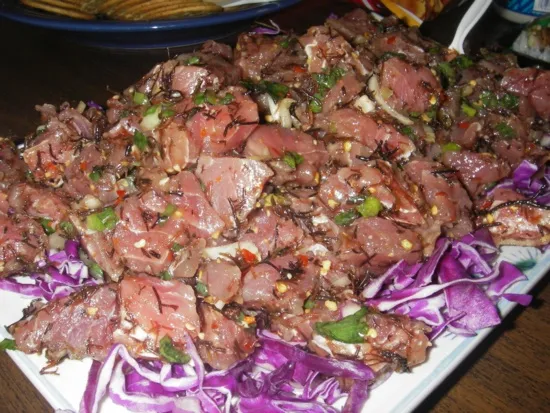
Photo: Sanba38 at English Wikipedia, CC BY-SA 3.0, via Wikimedia Commons
There's a moment every home poke enthusiast knows well: you've sourced beautiful ahi, cubed it up, poured on your marinade, and then... you wait. Maybe too long. Maybe not long enough. You plate it, take a bite, and it's fine — but it's not that. Not the kind of poke that makes you close your eyes and feel like you're somewhere near a beach in Honolulu.
The difference usually comes down to science. Not the intimidating lab-coat kind, but the practical, kitchen-level understanding of what acids, salt, temperature, and fish quality are actually doing to your tuna between the cutting board and the bowl. Once you get it, you can't un-get it — and your poke will never be the same.
The Acid Problem: When Your Marinade Starts Cooking Your Fish
Most poke marinades include something acidic — citrus juice, rice vinegar, or even a splash of ponzu. Acid is great for brightness and balance, but it's also doing something more aggressive: it's chemically denaturing the proteins in your fish.
This is the same process that makes ceviche work. When acid contacts raw fish proteins, it unravels them, causing the flesh to firm up and turn opaque. A little of this is fine — it can actually help the fish hold its shape when tossed with toppings. But leave acidic marinade on ahi for too long and you end up with a texture closer to canned tuna than fresh sashimi.
The sweet spot? For a marinade with any citrus or vinegar component, aim for 10 to 20 minutes maximum before serving. If you're working with a more traditional preparation that leans primarily on soy sauce and sesame oil — which are far less acidic — you can push that window to 30 minutes without much textural damage.
The takeaway: acid is your flavor friend and your texture enemy if left unchecked. Use it intentionally and watch your clock.
Salt and Osmosis: The Flavor Actually Goes Deeper Than You Think
Soy sauce is salty — obviously. But what that salt is doing in your marinade is genuinely fascinating. Through osmosis, salt pulls moisture out of the fish cells while simultaneously allowing the marinade's flavor compounds to move inward. This is why even a short soak in a well-seasoned marinade can produce ahi that tastes seasoned all the way through, not just on the surface.
The key is concentration. A marinade that's too heavy on soy sauce will draw out so much moisture that the fish becomes dense and overly salty. One that's too diluted won't penetrate meaningfully at all. A good ratio to work with at home: roughly one part soy sauce to one part a neutral or complementary liquid (sesame oil, a splash of mirin, or even a little water to dial back intensity).
Some chefs prefer a quick dry-salt treatment — a light sprinkle of flaky sea salt on the cubed ahi for five minutes before adding the wet marinade. This pre-seasons the fish and helps the subsequent marinade absorb more evenly. It's a small step that makes a noticeable difference.
Temperature: The Variable Nobody Talks About Enough
Here's something that gets overlooked almost every time: the temperature of your fish during marinating matters as much as the marinade itself.
Warm fish (say, ahi that's been sitting on the counter while you prepped everything else) will absorb marinade faster — but it also gives bacteria a window to multiply and causes the texture to degrade more quickly. Cold fish straight from the fridge slows everything down, which is actually what you want for control.
The professional approach: keep your cubed ahi in the refrigerator right up until you're ready to marinate, then let the marinade do its work in the fridge as well. This slows the acid's denaturing effect, gives you more predictable timing, and keeps food safety on your side. Never marinate raw fish at room temperature, even briefly.
Also worth noting: cold fish absorbs fat-soluble flavor compounds (like those in sesame oil or chili oil) more slowly than water-soluble ones (like soy or citrus). If your marinade is heavy on oil, a slightly longer cold-marinate time will give those flavors a chance to actually land.
Choosing the Right Ahi: Where It All Starts
No amount of technique rescues low-quality fish. When you're shopping for ahi to use in poke, the label "sushi-grade" is a start — but it's not a regulated term in the US, so you need to go further.
What you're actually looking for is fish that has been previously frozen to FDA-recommended temperatures (negative 4°F for at least seven days, or negative 31°F for 15 hours). This kills parasites and makes the fish safe to eat raw. Ask your fishmonger directly — a good one will know the answer. If they look at you blankly, shop elsewhere.
Visually, quality ahi should be a deep, vibrant red to pink — not brown, not gray at the edges. It should smell clean and oceanic, not fishy or sour. When you press a cube lightly, it should spring back rather than stay indented. Mushy texture before marinating means the cell structure is already compromised, and no marinade will fix that.
For the best access to quality ahi in the US, look for Japanese or Korean grocery stores, reputable seafood counters at higher-end supermarkets, or online sushi-grade fish suppliers that ship with dry ice. The extra effort is worth it every single time.
Putting It All Together
Here's a simple framework to carry into your next poke session:
- Start cold. Keep your ahi refrigerated until the moment you cube it.
- Watch your acid. If your marinade has citrus or vinegar, keep the soak under 20 minutes.
- Balance your salt. Don't go heavy-handed on soy — dilute it and taste as you go.
- Marinate in the fridge. Always. No exceptions.
- Source carefully. Ask questions at the fish counter and trust your eyes and nose.
Poke is a simple dish at its core, but simplicity rewards precision. Understanding what's happening at a molecular level — the proteins reacting to acid, the salt pulling and pushing flavor, the temperature controlling pace — turns you from someone who follows a recipe into someone who actually understands the craft. And that's when your home poke bowls start tasting like the real thing.