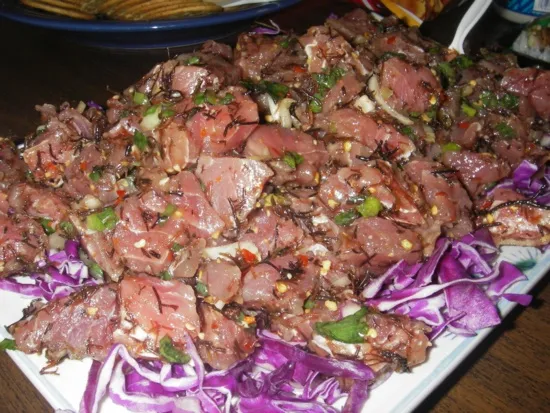
7 Hawaiian Poke Marinades You've Never Tried (But Absolutely Should)
Photo: PumpkinSky, CC BY-SA 4.0, via Wikimedia Commons
Ask most people on the mainland what goes in a poke marinade and you'll get a pretty consistent answer: soy sauce, sesame oil, maybe some ginger and green onion. And look — that's a solid foundation. Nobody's arguing otherwise.
But if you've ever eaten poke in Hawaii — really eaten it, at a fish market on the North Shore or a family cookout in Kalihi — you know that the flavor landscape is so much wider than what's made it to the continental US food scene. Hawaiian poke has deep roots in indigenous culture, Japanese immigration history, Filipino influence, and a modern chef community that's actively pushing the whole thing forward.
These seven marinades represent that full spectrum. Some are ancient. Some are regional. Some are the product of creative Hawaiian chefs who are done letting the mainland define their food. All of them are worth trying.
1. Pa'akai and Limu: The Original Poke
Flavor profile: Briny, mineral, deeply oceanic
Before soy sauce ever touched Hawaiian shores, poke was seasoned with pa'akai (Hawaiian sea salt) and limu (native seaweed). This is the original preparation — raw fish cured simply with salt and dressed with whatever edible seaweed was available along the coastline.
The most prized variety is limu kohu, a reddish, lacy seaweed with a pungent, almost funky flavor that's unlike anything you'll find at a mainland grocery store. It's intensely savory and slightly slimy in the best possible way. If you can track it down at a Hawaiian specialty store or online, it will completely reframe what poke can taste like.
Try it with: Plain white rice, a few drops of kukui nut (inamona), and nothing else. Let the fish and the sea do the talking.
2. Shoyu Poke: The Japanese-Hawaiian Classic
Flavor profile: Savory, umami-forward, subtly sweet
This is the style most Americans know, but it's worth understanding where it came from. Japanese plantation workers arrived in Hawaii in large numbers in the late 1800s, bringing with them soy sauce, mirin, and a tradition of eating raw fish. When that culinary sensibility met Hawaiian poke culture, shoyu poke was born.
Authentic shoyu poke goes beyond just soy sauce — it typically includes sesame oil, green onion, and inamona (roasted kukui nut paste), which adds a nutty, slightly bitter depth that sesame oil alone can't replicate. If you haven't cooked with inamona, it's the single ingredient most likely to make your mainland shoyu poke taste like the real deal.
Try it with: Pickled cucumber, furikake, and a bed of sushi rice.
3. Spicy Ahi: The Fusion That Became Tradition
Flavor profile: Creamy, spicy, rich
Spicy ahi poke — ahi tossed with Japanese mayo (Kewpie, specifically) and sriracha or togarashi — is a relatively modern creation, but it's become so embedded in Hawaiian food culture that it deserves a spot here. It shows up at nearly every poke counter in Honolulu and has become a gateway preparation for people new to raw fish.
The key is the mayo. Kewpie's higher egg yolk content and rice vinegar base give it a creamier, tangier profile than American mayo, and it coats the fish in a way that feels luxurious rather than heavy. Don't substitute.
Try it with: Crispy shallots, avocado, and a drizzle of chili oil for extra heat.
4. Opihi-Style Salt Cure: The Limpet Influence
Flavor profile: Intensely salty, clean, almost raw-tasting
Opihi are Hawaiian limpets — small shellfish harvested from rocky shorelines that are considered a delicacy and eaten raw with just salt. The opihi-style approach to poke borrows that same philosophy: minimal intervention, maximum quality.
This preparation uses a generous hand with coarse Hawaiian sea salt (red alaea salt, if you can find it — its iron-rich clay content adds an earthy complexity), a little seaweed, and sometimes a splash of fresh lemon. That's it. It's a marinade that demands exceptional fish because there's nowhere to hide.
Try it with: Thinly sliced Maui onion, fresh ginger, and a squeeze of calamansi if you can source it.
5. Miso-Ginger: The Big Island Influence
Flavor profile: Fermented, savory-sweet, warming
The Big Island has a strong Japanese farming heritage, and miso shows up in local cooking in ways that don't always make it to tourist menus. A miso-ginger poke marinade — white miso thinned with a little sake or mirin, fresh grated ginger, and a touch of honey — produces a fish that's deeply savory with a fermented complexity that soy sauce alone can't match.
White miso is milder and sweeter; red miso will give you something more intense and funky. Both work, depending on how bold you want to go.
Try it with: Shredded daikon, sesame seeds, and microgreens.
6. Coconut-Lime: The Polynesian Thread
Flavor profile: Tropical, bright, lightly sweet
Hawaii doesn't exist in cultural isolation — it's part of a broader Polynesian world, and that shows up in the food. A coconut milk and lime marinade draws on that wider Pacific influence, producing poke that tastes genuinely tropical rather than just Asian-inflected.
The trick here is using coconut milk sparingly and keeping the lime juice ratio low (remember, acid cures fish quickly). A short 10-minute soak is all you need. Some cooks add a pinch of chili flake or fresh Thai basil to bridge the coconut's sweetness.
Try it with: Mango salsa, toasted coconut flakes, and mixed greens instead of rice.
7. Kimchi Brine: The Korean-Hawaiian Crossover
Flavor profile: Funky, spicy, tangy, complex
Hawaii has a significant Korean-American community, and Korean flavors have been woven into local food culture for generations. Using kimchi brine — the liquid from a jar of well-fermented kimchi — as a poke marinade base is a move that's gained traction among younger Hawaiian chefs and home cooks who want big, layered flavor without a long ingredient list.
The brine is already packed with garlic, ginger, chili, and fermented funk. A small amount goes a long way. Add a splash of sesame oil and a little fish sauce and you've got something truly memorable.
Try it with: Chopped kimchi as a topping, crispy rice cakes, and a soft-boiled egg.
What makes Hawaiian poke so special isn't any single marinade — it's the spirit of using what's available, honoring where ingredients come from, and letting good fish speak for itself. Whether you go back to basics with salt and limu or push into kimchi brine territory, the goal is the same: a bowl that feels alive. Start experimenting, and you'll find your own version of that.